



"UPEI is where I built the foundation for everything that came next."
Peter's company Blanchard Growth and Performance Services helps executives, emerging leaders, and leadership teams navigate the challenges that matter most: developing leadership capability, strengthening team effectiveness, instilling operational excellence, leading through change, and creating workplace culture where people can thrive. Over the past decade, he has coached more than 500 executives across 35 countries and supported leadership development initiatives with organizations ranging from non-profits to Fortune 500 companies.
What brought you to UPEI? Why did you choose to study here?
I'm from Charlottetown and chose UPEI because I felt it was a place where I could succeed. The small class sizes, strong sense of community, and the people made it feel like the right environment for me to start the next phase of my life. I was also influenced by family who had positive things to say about their experiences at UPEI and Saint Dunstan’s. Both my father and uncle began their careers through UPEI, so I saw firsthand what was possible. Once I met the engineering faculty, I knew I had made the right decision. They genuinely cared about their students. It went beyond the academics; they cared about us personally, and later it became clear that their aim was to help us become professionals. UPEI gave me a clear, well-supported path forward, and that made all the difference early in my journey. Having worked across North America and Europe, I've come to appreciate that PEI offers something increasingly rare: space to think, connect, and grow. It's one of the reasons I'm now building leadership experiences and retreats that bring people together to learn, reflect, and develop in meaningful ways.
What did you find unique and interesting about the Engineering program?
What stood out most was the sense of community. The faculty invested in us both inside the classroom and outside of teaching. They took time to understand our goals, guide our decisions, and support us beyond the classroom. That sense of support extended across the entire program. Senior students welcomed us in, shared their experience, and helped us navigate the journey ahead. It created an environment where we worked hard, supported each other, and genuinely enjoyed the process. I have so many great memories from the social events, preparing for exams, and celebrating our success over the years. For me, these social dynamics and a sense of togetherness made all the difference. Looking back, that combination of high standards and strong community shaped my mindset, my confidence, and ultimately my early success. It felt like family, and there was no fear of failure.
What kinds of support did you receive during your time here from UPEI students, staff, and UPEI faculty members?
The level of support I received at UPEI was exceptional. The faculty was always accessible. If I had a problem that I didn’t understand, the faculty were generous with their time. They often took those moments to go beyond helping me understand a concept to mentor me—to guide my development, to help me see what I was not yet aware of, and to invest in my growth. They wanted us to succeed not just in school, but in our careers. Two experiences stand out. The first, Don Gillis, the Dean of Engineering at the time, showed up at my iron ring ceremony at Dalhousie years later to congratulate the other UPEI students and me. That level of care and commitment speaks to the kind of environment UPEI creates. The second, Wayne Peters, a professor at the time, gave me my first engineering job through an aquaculture research project he had launched. That opportunity gave me real-world experience and a significant advantage as I moved into my co-op program at Dalhousie. I had a leg up on the other students because I had real engineering experience under my belt before I left UPEI. Beyond faculty, the student community played a huge role. We supported each other academically and socially. We studied together, travelled to engineering competitions, and built friendships that have lasted decades. UPEI surrounded me with people who were invested in my success and whom I still keep contact today.
What opportunities have you experienced because you studied at UPEI, or because of the Island location?
UPEI gave me the opportunity to develop in an environment where I felt supported, connected, and able to focus. The balance between academics and social life played a big role in my success. I built strong friendships, stayed active, and developed a sense of wellbeing that allowed me to perform at a high level. UPEI has amazing sports facilities and we’d often head to the gymnasium for pick-up basketball, table tennis, and fitness training in between classes. With everything so close, we were able to flow from class to social to fitness to studies effortlessly, supporting a level of thriving that I still try to mirror in my life today.
Professionally, the opportunity to work as an aquaculture research assistant gave me my first real engineering experience, and it was something that set me apart as I moved forward in my career. Today, that relationship has come full circle. I now work with UPEI through the Office of Continuing Education and Professional Development, delivering programs in areas like strategic thinking, leadership, and change management. UPEI’s faculty quietly equipped me with the mindset, competencies, character qualities, and habits necessary to thrive in my career—the intangibles that go beyond the academic theory. They shaped me into a professional before I turned 20, and that speaks to the strength of a UPEI community that continues to create opportunities long after graduation.
What's unique about UPEI, and Prince Edward Island, in your experience?
It's the deeply human culture—in other schools you feel much more like a number in a chair—but at UPEI I felt like I was part of a family both in engineering and across the wider campus. The faculty was accessible and eager to support my learning when I had problems, so I always felt like there was a way to success. If I didn’t understand something in my studies I could ask questions in class, ask other students and if we were stuck faculty would support us outside the classroom during office hours. There was always a way to succeed. People genuinely cared about each other and it felt deeply human. The facilities provided us with everything we needed to thrive; for study, social, wellbeing, exercise and more. I truly believe we are a product of our ecosystem and how we bloom, the degree to which we flourish is largely affected by what’s in the ecosystem. UPEI creates an ecosystem for students to thrive rooted in Island culture. There was less noise and distraction at UPEI compared to other schools. There was some feeling of competition at UPEI among students but even this felt less severe compared to other schools and that supported a collaborative spirit and an approach of oneness to our degree. I had no conflicts at all throughout three years of study with students or faculty. I feel like that’s quite remarkable. We respected each other, we were honest with each other, we included one another, and we invested in one another so we could all mutually succeed. Everyone went together. No one was left alone, and if someone was struggling, we would rally to their side. I can even remember professors giving us nudges to help other students who they could see were slipping behind and we did. There was leadership at all levels of the faculty and student body. It really was remarkable how much we learned, how much fun we had, and how many amazing memories we created in such a short time. There was no fear of failure, no doubt that we would succeed if we did the work.
What would you tell a student considering UPEI?
If you’re considering UPEI, you’re choosing an environment where you can truly grow. You’re given what you need to succeed academically, but more importantly, you’re gifted a safe space to grow as a person. It’s a place where you can build confidence, develop discipline, and learn how to succeed so you get your career off on a good foot. What makes UPEI special is the people. The faculty invests in you. Your peers support you. You’re more than a number; you’re part of a community that wants to see you succeed. And that matters more than most people realize. Because success isn’t just about intelligence or capability. It’s about the environment. UPEI creates an environment where you can thrive, build meaningful relationships, and develop the habits that will carry you forward for the rest of your life. UPEI is where I built the foundation for everything that came next.
What did come next? What is your current career?
I’m the founder of Blanchard Growth and Performance Services, where I work with leaders and teams navigating high-stakes challenges to grow through the hard moments and create sustainable success. I like to say I’m an engineer who fell in love with coaching. Today, I spend most of my time working with executives and teams across industries, supporting them to solve complex problems, lead change, and perform at a high level in an increasingly demanding world. Over the course of my career, I’ve coached more than 500 executives across 35+ countries and collaborated with faculty from institutions such as Yale, Stanford, Berkeley, MIT, Wharton, and the Columbia Business School. But my path to here hasn’t been linear. I began my career in mechanical design and capital project engineering. I eventually moved into global leadership roles at Michelin, where I led engineering teams to deliver projects worldwide, culminating in the engineering leadership of a €100M factory transformation project in Scotland. It was while leading this transformation project that I would hit the first crisis in my career, and truthfully, my life. Just months before completion, we experienced a devastating factory closure impacting 850 people. That moment changed me. It felt like being hit in the gut by a train. All that we had been racing towards, that I had uprooted my life to go create was taken away from us in a moment. It forced me to turn inward, to reflect on who I was, what truly mattered, and how I wanted to show up in the world. I realized that leadership isn’t just about results, it’s about presence. It’s about how you show up for people in their hardest moments and how you help them get from A to B. Luckily, I had been studying professional coaching in London at the time. My aim was to become a better leader through the coaching skillset, but what I discovered was a modality that didn’t just help you solve the outer problems; it also helped you to get clear on and resolve what’s going on inside. I was benefiting so much from the coaching I was receiving that I kept saying to myself, the world needs this. Imagine where I’d be if I had discovered this sooner in life. It was in that moment that I really found my calling, and with 850 people being made redundant overnight, I had the opportunity to step into it immediately.
"Our most meaningful growth is forged out of hardship and adversity, so long as we can go through it in a sustainable way. That’s what I love to do most. To join people who are in tough situations, navigating through the challenges of modern life and leadership."
I took my engineering hat off and immediately began career coaching employees across the factory, co-developing a site-wide resilience plan, and leading social support activities to champion the 850 employees impacted by redundancy. The aim was to create an approach that would support everyone in moving through the hardship we were collectively facing and landing well in their next step, whatever that may be. I can remember leaving the warehouse one day after a morning of coaching warehouse employees. As I was leaving, the warehouse supervisor looked up and said, “I hope you plan on doing that for the rest of your life”. I asked, “What makes you say that?” He responded, “Because in 30 years, I’ve never seen anyone leaving a conversation with a senior manager the way they come out of that meeting room after talking to you.” Those words changed me. I knew I had found it. I had found my calling. That experience led me to discover my calling and ultimately to launch my business.
"I believe that leadership challenges are rarely just talent related or business problems. They are growth opportunities disguised as operational issues. The best leaders learn to navigate both the external challenge and the internal growth it demands."
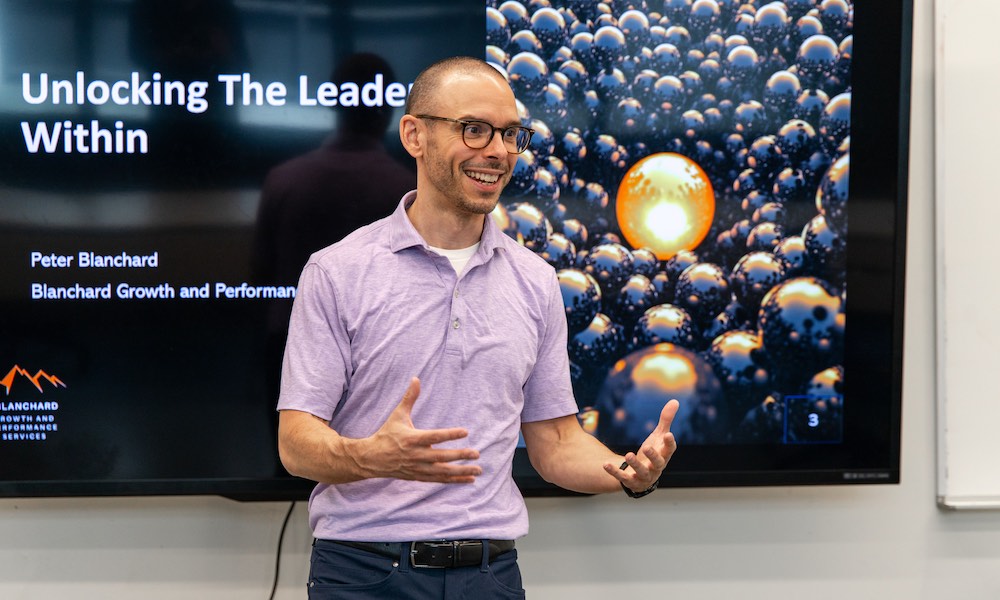
Today, I help leaders do what I had to learn in real time: navigate complexity, lead with clarity, take care of themselves, grow through the hard stuff and move their teams forward with trust, care, and purpose. I believe our most meaningful growth is forged out of hardship and adversity, so long as we can go through it in a sustainable way. That’s what I love to do most. To join people who are in tough situations, navigating through the challenges of modern life and leadership. Recently, I’ve been looking at how I can make myself more accessible and so I launched an annual program called “Win Within”. I hope to bring more people together and better support individuals to live life fully and rise meaningfully in their careers. In short, it’s an invitation to journey inward and get clear on your own North Star. It’s designed to help people align their work, well-being, relationships, and personal aspirations around what matters most. It creates an inner foundation that they can grow off supporting them to be more resilient and persevere through the challenges of modern life and leadership. When you’re connected to your own North Star, every moment becomes a learning opportunity, and you convert more of the potential that each moment holds into meaningful progress. It’s amazing to see how people light up and what they create when their fully connected to their own inner light. If interested, you can connect with me on LinkedIn and I’ll send you “The Win Within Scorecard” so you can immediately take stock of your life and discover the one thing that is going to make the biggest difference for your right now. Two candles will illuminate a dark room better than one. That’s the way I see it. We focus on the one thing that is most important to us, support each other through community, and I create a structure that helps people make consistent progress. That’s been my philosophy for life. When you grow in the direction of your own North Star, it’s amazing what can happen. I’m living proof.
How do you feel UPEI has prepared you for that career, and what role has UPEI played in your successes?
UPEI gave me something far more valuable than what I signed up for, which was technical engineering knowledge; it taught me how to learn, how to think, and how to grow. It was a place where I would build confidence, discover my strengths, and develop the discipline required to succeed. The faculty taught us so much more than engineering. They taught professionalism, accountability, and how to show up with integrity. They were professional in their approach and demonstrated good character. They were models of who we, the students, aspired to become and they invested in us heavily both inside and outside of the classroom. One moment that stayed with me was when I asked my Dean, Don Gillis, what elective I should take. He said, “Peter, take philosophy.” At the time, I laughed and said, “Come on, Don, I’m an engineer, are you joking?” Looking back, it was one of the most important decisions I made. That philosophy course opened my mind to new ways of thinking and grounded me in a principle that still guides me today: the importance of knowing what you don’t know. I don’t know if Don knew exactly what would happen but he knew what I needed and he pointed me in the right direction. I emerged from that course with a balance of confidence and humility that became foundational not just in my engineering career, but in my work today as a coach. UPEI didn’t just prepare me for a job. It prepared me for a lifetime of growth.
Connect with Peter on LinkedIn - "I love connecting with people, hearing their stories and seeing how we can support one another to bring our dreams to life while moving the world forward."


