


Stepping into the role: How standardized patients help shape health education
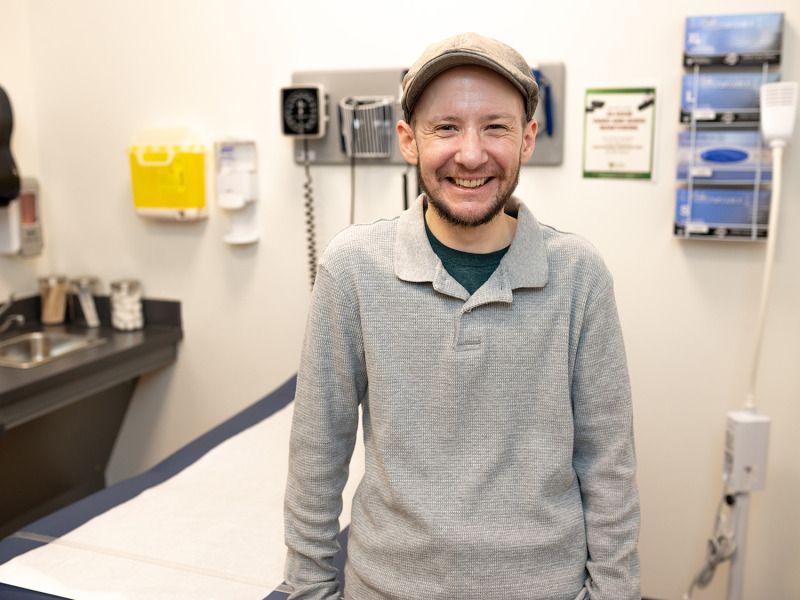
At the University of Prince Edward Island, community members are helping shape the next generation of health care professionals. Through the standardized patient (SP) program, housed within the UPEI Faculty of Medicine, trained participants work alongside learners from medicine, nursing, and other health disciplines to create realistic patient interactions that build confidence, communication skills, and empathy.
Standardized patients (SPs) are Island residents trained to assume the role of patients in simulated clinical sessions, helping learners practice everything from taking a medical history and performing physical exams to navigating difficult conversations. These simulations take place in the Clinical Learning and Simulation Centre at the UPEI Faculty of Medicine and Health Sciences Centre and are a welcome addition to the manikin-based training offered there, giving learners valuable experience working with a real person.
For standardized patient Jay Gallant, the experience has been both rewarding and unexpectedly fun.
“Being part of helping to train future health-care professionals is very rewarding in itself,” said Gallant. “It’s also a very fun experience to see how it all works from a health-care professional’s point of view.”
Gallant, a Charlottetown-based actor, has played many roles on stage and screen, but some of his most diverse work has taken place at UPEI over the past 11 years as an SP for the Faculty of Nursing and an animal owner actor for the Atlantic Veterinary College. Through simulation-based learning, he has stepped into the shoes of someone living with anxiety and depression, a patient managing stomach ulcers, and even a person looking for support to quit smoking. No two scenarios are the same, and for Gallant, that unpredictability is part of what makes the experience so meaningful.
“It’s an adventure,” he said. “You never know what’s coming at you next in terms of the kind of roles you’ll be offered.”
One unique aspect of the program is that SPs do not need acting experience to get involved. Standardized patients receive training and support to help them feel comfortable stepping into each role.
“The trainers will help you get into that role,” Gallant explained. “There’s always support, and there’s never pressure to put yourself in an uncomfortable situation.”
“We have a roster of excellent standardized medical educators who help our SPs get comfortable with the role they are playing,” said Rob Squire, manager of the SP program. “All we need from the SPs is a flexible schedule and a drive to help our learners learn and grow in the clinical setting.”
The program also includes guidance on how SPs can “de-role” after simulations to help them step out of character and maintain psychological safety after emotionally heavy scenarios. SPs can also provide direct feedback to learners, offering insights from the patient perspective that support their growth.
The program is used by faculties across UPEI, including the Atlantic Veterinary College, Nursing, and Science, as well as by medical learners at the Memorial University of Newfoundland Regional Campus at UPEI, and other health professionals from Atlantic Canada who come to PEI to retrain. As the UPEI Faculty of Medicine continues to grow, the SP program is helping shape future health-care professionals who are not only clinically skilled but also compassionate, empathetic, and patient-centred.
If you are interested in applying, please visit https://medicine.upei.ca/standardized-patient-program/


