

UPEI community takes part in National Indigenous Peoples Day Lunch and Learn
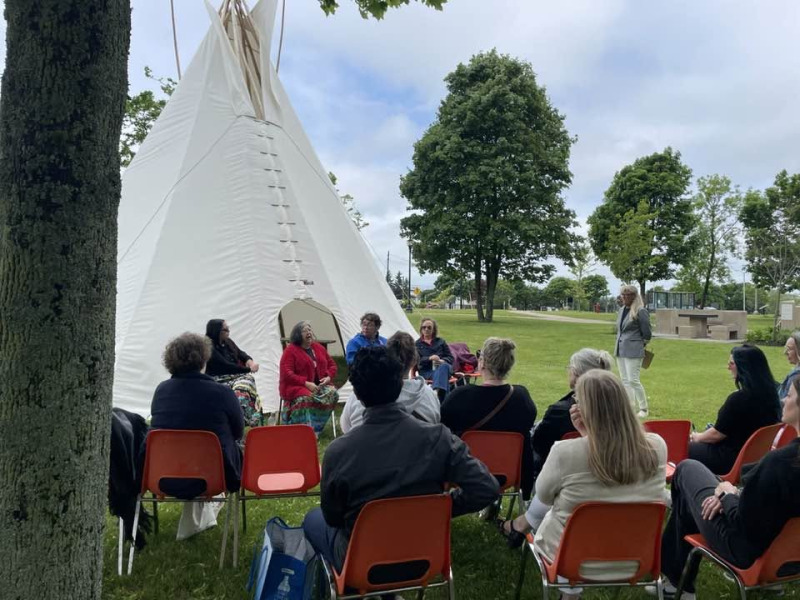
In recognition of National Indigenous Peoples Day on June 21, Dr. Corinne Chappell, UPEI Advisor on Indigenous Affairs, led a Lunch and Learn session on Friday, June 19, from 12:00 to 1:30 pm, held outdoors near the tipi located in the campus quad.
Joining Chappell as panellists were Morgan Varis, sessional lecturer, Faculty of Indigenous Knowledge, Education, Research, and Applied Studies (IKERAS); Dr. Judy Clark, UPEI Elder-in-Residence and Advisor to the Dean, Faculty of IKERAS; Doris Googoo, senior lecturer and language instructor, Faculty of IKERAS; Erin Reid, assistant professor, Faculty of IKERAS; and Jolene Rolle, coordinator, Mawi’omi Indigenous Student Centre.
The session was structured as an interactive question-and-answer discussion. Participants were invited to submit questions anonymously or ask them in person, creating a welcoming environment for open dialogue and learning. The format encouraged attendees to explore topics they may have otherwise been hesitant to raise while deepening their understanding of Indigenous cultures and experiences.
Discussion topics throughout the session included the use of appropriate terminology, Indigenous rights, truth and reconciliation, residential schools, identity, status, colonial violence, and ongoing discrimination, including the perpetuation of common stereotypes.
One question around status prompted Elder Judy Clark to speak about the 150 plus-year-old Indian Act, which defines who is "Indian." To this day, the Canadian government still assigns registration numbers to Indigenous Peoples of Canada who are members of the 638 First Nations and the eight Metis settlements that are recognized in the Act (the Inuk have their own administered system and land claim agreements with the Crown).
Clark spoke about how it is important to educate all Canadians about the devastating impacts of both the Indian Act and the residential school system on Indigenous peoples and the efforts by Indigenous activists to seek justice. She shared the examples of two Indigenous women from the Maritimes who played pivotal roles in challenging discrimination and fighting for equality.
Former Senator Sandra Lovelace Nicholas, from Tobique First Nation in New Brunswick, received international recognition in 1979 for petitioning the United Nations Human Rights Committee over the treatment of Indigenous women and children in Canada by the government. In 1985 she succeeded in having Parliament revoke a discriminatory section of the Indian Act, which had caused women marrying non-Aboriginals to lose status, also depriving their children of status, but did not treat men the same who married non-Aboriginal women.
Nora Bernard of Millbrook First Nation in Nova Scotia, a residential school survivor, initiated a landmark class-action lawsuit that helped secure the Indian Residential Schools Settlement Agreement, which laid the groundwork for the Truth and Reconciliation Commission. Her advocacy brought national attention to the legacy of residential schools and contributed significantly to reconciliation efforts in Canada.
Panellists also addressed questions regarding language that may be considered offensive.
Chappell offered the example of “Let’s get together for a pow wow,” which is sometimes used casually to refer to meetings. She emphasized the importance of addressing such language respectfully, explaining that it can be inappropriate.
Varis expanded on the impact of language, highlighting expressions such as “the lowest rung on the totem pole” as harmful and disrespectful. “This is very offensive, and you don’t know who may be listening and affected by that language,” she said.
Following the discussion, participants gathered for refreshments, including blueberry cake, and were invited to take part in a smudging ceremony inside the tipi.


