


Canadian Wildlife Health Cooperative Atlantic turns on the bat signal!
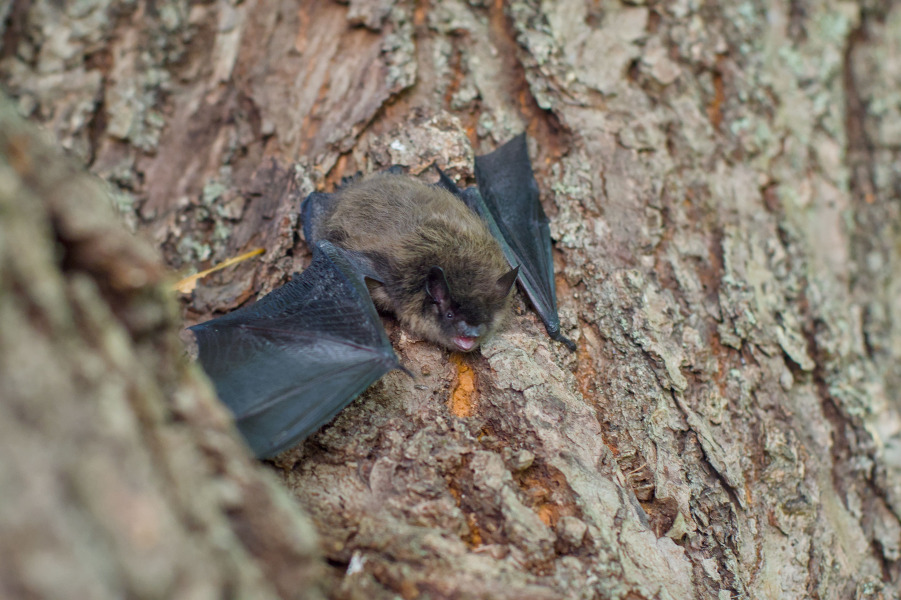
Spring is here, and bats in Atlantic Canada are on the move. Several species are emerging after winter hibernation, flying from caves, mines, and possibly wells to their summer homes. Meanwhile, migratory bat species are flying north from southern latitudes to this region.
The Canadian Wildlife Health Cooperative (CWHC) Atlantic bat team is asking the public to report sightings of the elusive nocturnal animals by calling the Atlantic Bat Hotline at 1-833-434-BATS (2287).
Members of the public can play an important role in helping biologists better understand the status and distribution of bats by reporting sightings in Prince Edward Island, Newfoundland and Labrador, New Brunswick, and Nova Scotia. Callers can report details of their bat sightings and receive up-to-date, accurate information on a variety of bat-related topics, including general biology and ecology, bats and human health, responsible management of bats in buildings, and practical solutions to support bat conservation on private property.
Each bat report is important to fill in gaps and help scientists learn more about where and when local bat species are spotted.
“By combining hotline reports with all the surveys conducted by regional biologists,” said Jordi Segers, CWHC Bat Health Program Coordinator, “we can work together to understand more about the status of our local bat species and work towards protecting them. So, reach out today if you have a bat to report!”
The health of resident bat species in Atlantic Canada continues to be threatened by the persistence of the devastating bat-specific disease white-nose syndrome (WNS). The rapid decline of hibernating bat species from WNS resulted in three local bat species—Little Brown Myotis, Northern Myotis, and Tri-colored Bat—being federally listed as endangered.
At the same time, migratory bats—Hoary Bat, Eastern Red Bat, and Silver-haired Bat—that visit Atlantic Canada from the spring to the fall are facing population declines due to collisions with an increasing number of wind turbines. Severe population declines in migratory bats across Canada prompted the Committee on the Status of Endangered Wildlife in Canada to recommend to Environment and Climate Change Canada (ECCC) that these bats be listed as endangered as well. Migratory bat species are under-reported, but public reports complemented by photographic observations may help identify these species in Atlantic Canada.
The Atlantic Bat Hotline is offered through the CWHC, Atlantic Region, at the Atlantic Veterinary College, University of Prince Edward Island, as part of the project “Signals of Bat Health.” This project represents a regional collaboration involving the CWHC, ECCC, the four provincial governments, and various environmental non-governmental organizations, and is integral to the recovery of endangered bat species in Atlantic Canada.
Funding for this project is provided in partnership by the ECCC Habitat Stewardship Program–Species at Risk; Newfoundland and Labrador Department of Forestry, Agriculture and Lands; Prince Edward Island Forests, Fish and Wildlife; New Brunswick Department of Natural Resources and Energy Development; and Nova Scotia Department of Natural Resources.
For more information about bats, contact Darrian Washinger, Atlantic Bat Conservation Project Technician, Canadian Wildlife Health Cooperative, Atlantic Region, at (902) 894-2845/1-833-434-BATS (2287) or atlanticbats@cwhc-rcsf.ca.


