




UPEI student startup SeaHand Systems makes history with international win
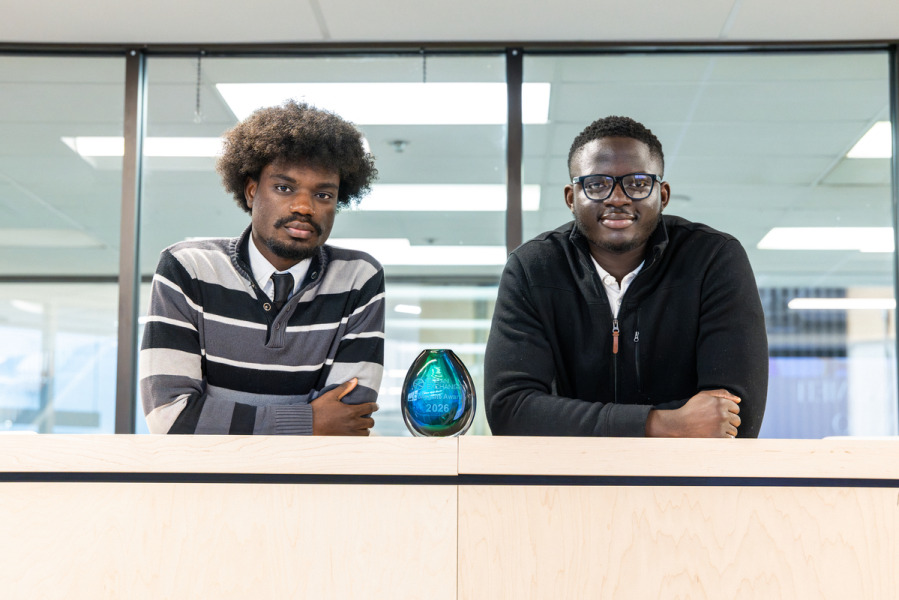
SeaHand Systems, founded by recent UPEI sustainable design engineering graduate Oluwatobi “Tobi” Oriade and current computer science student Daniel Odoom, recently became the first startup company supported by the Catherine Callbeck Centre for Entrepreneurship (CCCE) to win an international competition. In a milestone moment for UPEI’s entrepreneurial community, Oriade (Class of 2026) and Odoom (Class of 2027) claimed the $10,000 USD Collegiate Award at the 2026 Ocean Exchange in Florida.
Alongside oyster farmer Aaron Sweet, Oriade and Odoom are developing automated technology to flip oyster cages. For oyster farmers, flipping heavy, 100-pound cages in the water hundreds of times a day is gruelling, back-breaking work. Thanks to this breakthrough from the UPEI startup, the aquaculture industry is getting a much-needed helping hand.
Oriade, originally from Nigeria, and Odoom, who was born in Ghana and raised in Qatar before coming to Canada for university, both arrived at UPEI with a passion for building impactful solutions. Before joining forces, each had navigated the highs and lows of early ventures—Odoom with an on-demand tech rental service, and Oriade with a web design agency and an AI marketing startup.
Both Oriade and Odoom were both involved with the CCCE since its inception in 2024, but their first opportunity to work together came in 2025 during the Pitch Battles competition. They were paired together and went on to win the entire aquaculture-themed competition. Their partnership, forged from the competition, grounded a shared curiosity with complementary technical backgrounds and sparked their continued pursuit of helping the aquaculture sector.
Rather than jumping straight into engineering a product, the pair committed to rigorous customer discovery, a core principle emphasized through UPEI’s Harry W. MacLauchlan Entrepreneurship Program (HWMEP). They spoke with roughly 30 oyster growers across Canada and the United States, quickly realizing their initial concept wasn't what the market needed. They pivoted entirely after a large grower managing 25,000 cages identified manual cage flipping as his biggest operational headache.
“You create a business when you take a technology and create real economic value for the person using it, and you only find out what they value by putting it in front of them,” said Oriade. “That’s why SeaHand is the one I'm sticking with: the problem came from growers, not from me.”
Adding Sweet as their third co-founder ensured the team stayed grounded in the day-to-day realities of working on the water.
Moving from software to physical hardware brought steep financial and technical hurdles, as every physical prototype requires significant time and capital. SeaHand Systems leaned heavily on the mentorship and programming at the CCCE, including guidance from staff members Amy Andrews, Jeremy Heartz, and Reefah Shehnaz, as well as the practical business fundamentals taught in the HWMEP.
“The HWMEP taught me how to refine and really understand a business,” says Odoom. “If you're going to ask someone to invest in your business, you have to understand it better than anyone else. You need to know your numbers, question your assumptions, take feedback, and explain why someone should believe in what you're building.”
Oriade echoes that sentiment, noting that preparing for UPEI’s Panther Pitch forced him to look beyond engineering to answer critical commercial viability questions about unit economics and customer adoption.
That preparation paid off. After winning the Ocean Startup Challenge (a competition launched by the Ocean Startup Project, a Canadian collaboration that inspires, funds, and accelerates sustainable ocean technology startups) and incorporating SeaHand Systems in September 2026, the team was selected as one of 10 collegiate finalists across North America for the Ocean Exchange, which recognizes innovative solutions advancing ocean sustainability.
Before travelling to Florida for the competition, Odoom and Oriade brought their pitch back to the CCCE for final feedback and refinement. They believe the combination of rigorous preparation and hands-on networking led them to winning the Collegiate Award.
“Seeing SeaHand Systems earn recognition on an international stage is a proud moment for both their team and the UPEI entrepreneurial community. They put in the hard work to validate their idea, listened closely to industry needs, and built a truly impactful solution. We are thrilled to see their dedication pay off and excited to watch what they accomplish next,” said Amy Andrews, Manager of Entrepreneurship at the University.
“Once I got to Florida, I felt like I was in my element,” says Odoom. “I was networking, talking about what we were building, making connections, and even asking whether people knew potential customers. I could actually see myself applying what I had learned through HWMEP and the Centre’s programming.”
With competition winnings and university support fueling their momentum, SeaHand Systems is currently building its first full-scale prototype, with the next major milestone being field trials on a working oyster farm.
Long-term, the founders envision SeaHand becoming a premier aquaculture automation company, building a suite of reliable, affordable tools to ease labour shortages and help growers scale their operations.
For fellow UPEI students sitting on an idea, the founders offer simple advice: start now, stay coachable, and tap into the community around you.
“Don’t let yourself become the first limitation on your idea,” says Odoom. “You don't know what you need until you start, and you don't know what an idea can become until you give it a chance.”
Did you know? This isn’t the first time UPEI students have engineered a solution for flipping oyster cages. In 2016–2017, Jordan Sampson, Brett McDermott, and Dylan MacIsaac developed equipment that gently guides the oyster cages in a rollercoaster-like flip as part of their Faculty of Sustainable Design Engineering studies. SeaHand Systems, inspired by the 2017 group, has been innovating on the original design, which Sampson, McDermott, and MacIsaac patented in 2023 with the help of UPEI.


