







UPEI assistant professor appointed as a Tier 2 Canada Research Chair

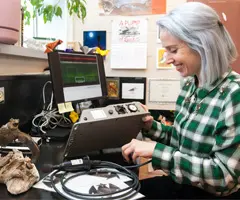
The University of Prince Edward Island (UPEI) is pleased to announce that Dr. Hala Mreiwed, Assistant Professor in the Faculty of Education, has been appointed as a Tier 2 Canada Research Chair (CRC) in Children, Youth and their Educational Geographies.
Dr. Mreiwed’s appointment was part of a national announcement made on Friday, October 23, 2026, in Hamilton by the Tri-agency Institutional Programs Secretariat as part of a major federal investment in Canadian research and research institutions.
A Tier 2 Canada Research Chair is a designation reserved for exceptional emerging researchers acknowledged by their peers as having the potential to lead in their field. In this capacity, Dr. Mreiwed will receive $600,000 in funding over five years. This includes $100,000 annually over the five-year term, alongside an additional $20,000 annual research stipend awarded to first-term Tier 2 Chairs. The position represents one of UPEI's allocated Social Sciences and Humanities Research Council (SSHRC) chairs within its total allocation of nine CRCs.
"I am thrilled to welcome Dr. Hala Mreiwed to UPEI, with her ambitious and innovative research projects centred on equity broadly, and children’s rights specifically,” said Dr. Marva Sweeney-Nixon, Associate Vice-President, Research and Dean of Graduate Studies, and Chair of UPEI's Canada Research Chair Search Committee. “She will study topics such as privacy rights, online harms to children and AI influences. Another project is transforming the Convention on the Rights of the Child from a symbolic text to lived experience using creative drama. Her publications, scholarly presentations and public policy work with NGOs position her on the international stage, and we look forward to what is next.”
In addition to her CRC funding, Dr. Mreiwed will receive $74,964 through the Canada Foundation for Innovation's John R. Evans Leaders Fund (JELF) in collaboration with the CRC Program, supporting the critical research infrastructure required to advance her work.
Dr. Mreiwed’s research focuses on children’s rights research and education with and by children and youth (under the age of 18) and pre-service teachers in Atlantic Canada's Bachelor of Education programs as co-researchers/co-creators of knowledge. Through participatory action research and arts-based activities such as creative drama, Dr. Mreiwed aims to understand how the educational geographies and lived experiences of children and youth, and pre-service teachers shape their perceptions and realization of children’s rights. Her Children's Rights Research and Education (CRRE) Lab will use this knowledge to identify supports and generate new resources for teaching and learning about children's rights. The CRRE Lab is an interdisciplinary hub for research, training, community outreach, and resources on children’s rights education in rural Atlantic Canada.
“Advancing equity, diversity, inclusion, and accessibility, alongside strengthening research, creative activity, and knowledge mobilization, are key priorities for the faculty,” said Dr. Miles Turnbull, Dean, UPEI Faculty of Education. “Dr. Mreiwed's research program will make a significant contribution to both objectives.”
Congratulations, Dr. Mreiwed!
About the Canada Research Chairs Program
The Canada Research Chairs Program (CRCP) stands at the centre of a national strategy to make Canada one of the world's top countries in research and development. It invests approximately $311 million per year to attract and retain a diverse cadre of world-class researchers, to reinforce academic research and training excellence in Canadian postsecondary institutions.
In 2000, the Government of Canada created a permanent program to establish 2,285 research professorships—Canada Research Chairs—in eligible degree-granting institutions across the country.
Chairholders aim to achieve research excellence in engineering and the natural sciences, health sciences, humanities, and social sciences. They improve our depth of knowledge and quality of life, strengthen Canada's international competitiveness, and help train the next generation of highly skilled people through student supervision, teaching, and the coordination of other researchers' work.


