





UPEI graduate students to compete in Falling Walls Lab Atlantic Canada competition on September 14

Two master’s students in the UPEI Faculty of Sustainable Design Engineering will participate in the Falling Walls Lab Atlantic Canada competition on September 14 in Halifax, Nova Scotia.
They will be among 14 of Atlantic Canada’s top students and early-career researchers who will each have just three minutes to pitch their innovative research ideas and share the wall they want to break at the Halifax event. The winner will represent Atlantic Canada at the Falling Walls Lab Global Finale in Berlin, Germany, in November, joining 100 finalists from around the world.
B.K.R. Kaushik Raja’s pitch, “Breaking the Wall of Food Waste,” looks at how food is graded for quality. The grade given to each item is often a visual judgement, and when that judgement goes wrong, usable food can be rejected. One Swiss study found that about half of all potato losses came from potatoes failing quality standards, and only a quarter to a third of those were about food safety. Raja’s research uses cameras and image analysis to measure surface blemishes on frozen French fries, and his pitch proposes extending that measurement to grade whole potatoes on a processing line, with each new product validated in turn.
“I spend most of my time on problems that only a handful of people in my field would recognize,” said Raja. “Three minutes in front of a room that has never heard of this work is a harder test than any exam I have written, and it is the reason I applied.”
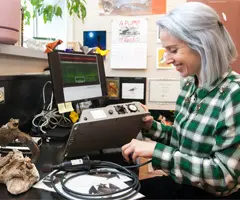
Ashutosh Pathare’s pitch, “Breaking the Walls of Thermal Food Imaging,” uses infrared thermal imaging and machine learning to predict chicken egg freshness without breaking the shell. The project analyzes the thermal signature of the egg’s air cell and combines custom hardware, image processing, machine learning, and infrared thermal imaging to support fast and accurate quality assessment.
"Being selected for the Falling Walls Lab Atlantic Canada competition means a lot to me,” said Pathare. “It’s an opportunity to take research that usually stays within the walls of a lab and share it with people outside my field to show that even the food on your plate has untapped science in it and can be a starting point for real innovation.”
Raja and Pathare are conducting their graduate studies under the supervision of Dr. Senthilkumar Thiruppathi, Industry Research Chair in Sustainable Food Automation and an Assistant Professor in the Faculty of Sustainable Design Engineering.
The finalists in the Falling Walls Lab Atlantic Canada competition represent Dalhousie University, University of Prince Edward Island, University of New Brunswick, Mount Allison University, Nova Scotia Health Authority (Dartmouth General Hospital), and the broader Atlantic innovation community. Their ideas include food waste, pharmaceutical waste, greenhouse gases, maternal and child nutrition, IUD pain, AI decision-making, healthcare access, diagnostics, athletic performance, and more. For more information about Falling Walls Lab Atlantic Canada, visit https://falling-walls.com/falling-walls-lab-atlantic-canada
UPEI acknowledges the assistance of Canada’s tri-council of federal granting agencies—Natural Sciences and Engineering Research Council of Canada (NSERC), the Social Sciences and Humanities Research Council (SSHRC), and the Canadian Institutes of Health Research (CIHR)—through its Research Support Fund (RSF), which helps fund services and infrastructure that support research activities at the University. In 2026–2027, UPEI’s RSF allocation is $1,399,214.


