

New series marks anniversary of PEI’s foray into renewable energy and resource self-sufficiency in 1976
In 1976, Prince Edward Island made a foray into renewable energy and resource self-sufficiency in two major ways: the holding of a four-day forum in the spring about high energy costs and the opening of the Ark, a futuristic building constructed at Spry Point, the following fall.
To mark the 50th anniversary of these events, Dr. Josh MacFadyen, Canada Research Chair in Geospatial Humanities at UPEI, has launched a three-part series of articles and video podcasts titled “PEI & The Spirit of ’76” (part one). He and Dr. Alan MacEachern, professor of history at Western University, co-wrote the articles and podcasts.
The second part of the series deals with rising costs of energy at the time and PEI’s “grand experiment in self-sufficiency and sustainability.” In the spring of 1976, the province held a four-day forum called “Energy Days” that focused on addressing its high energy costs—a topic at the forefront of people’s minds these days. One of the keynote speakers at the forum was Dr. Amory Lovins, then a 28-year-old physicist from Oxford. MacFadyen and MacEachern interviewed Lovins, now one of the world’s leading energy scientists, co-founder of the Rocky Mountain Institute, and an instructor at Stanford University, for the series and recorded a podcast with him on YouTube.
In the third part of the series, MacFadyen and MacEachern interviewed David Bergmark and Ole Hammarlund, the main architects of the Ark.
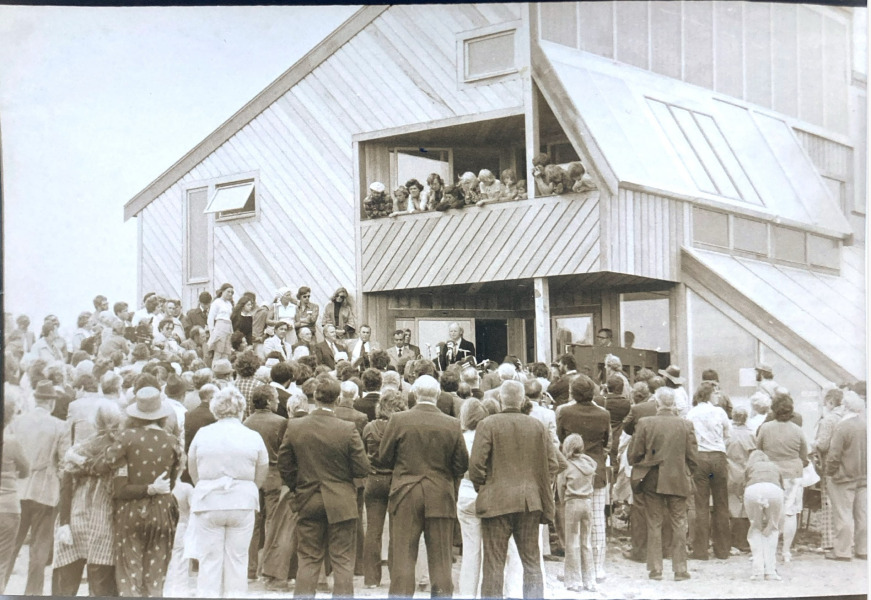
The Ark was officially opened on September 20, 1976, at a ceremony attended by then-Prime Minister Pierre Elliot Trudeau, then-PEI Premier Alex B. Campbell, and hundreds of guests. Developed by Massachusetts-based New Alchemy Institute with support from the federal and provincial governments, it was a “bioshelter,” simultaneously a place to experiment on and showcase integrated agricultural, aquaculture, and renewable energy systems, and a single-family home.
“Futuristic and domestic, ultramodern and back-to-the-land, the Ark captured the imagination like no other project of its day,” said MacFadyen.
The Ark included solar heating with mass heat storage, a high-efficiency wood stove, a wind turbine generator, composting toilets, and a passive solar agri/aquaculture greenhouse—elements of sustainable design today. Among its features were a rock and water heat storage basement, superinsulation of walls and roof, ultraviolet and infrared-permeable glazing on the greenhouse windows, and minimization of exterior surface and edges.
The project drew national and international attention at first. In the summer of 1977, 15,000 people visited the Ark where Bergmark and his family were living. After about 18 months, they moved out because of the mass of visitors day and night. The building was turned over to the now defunct PEI Institute of Man and Resources, a provincial agency looking at alternative energy. The Ark closed in 1981, and over the next decade, it was used for community and commercial activities before being sold and converted to a restaurant in 1991. The building was demolished in 1999.
“Alan and I knew that this anniversary was approaching and always wondered if Amory and the architects had any interest reflecting on their contributions,” said MacFadyen. “The result helped mark a significant contribution to sustainable development in the region as well as new ways of thinking about energy across North America.”
UPEI acknowledges the assistance of Canada’s tri-council of federal granting agencies—Natural Sciences and Engineering Research Council of Canada (NSERC), the Social Sciences and Humanities Research Council (SSHRC), and the Canadian Institutes of Health Research (CIHR)—through its Research Support Fund (RSF), which helps fund services and infrastructure that support research activities at the University. In 2026–2027, UPEI’s RSF allocation is $1,399,214.


