







UPEI computer science graduate’s technology empowers gamers with disabilities
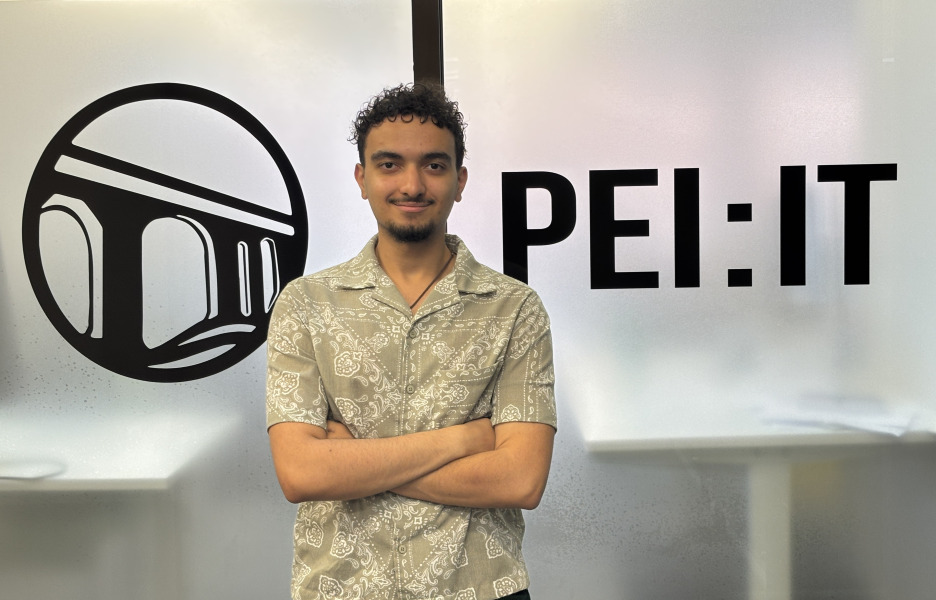
A new open-source application developed by University of Prince Edward Island computer science graduate Bassam Kamal is rapidly gaining adoption in major health-care institutions and adaptive gaming programs across North America. Designed to simplify setup for the QuadStick, a mouth-operated controller used by individuals with quadriplegia, the software is streamlining clinical workflows and empowering gamers with physical disabilities.
Kamal developed the initial concept for the QuadStick Configuration Manager during a user experience (UX) course taught by Dr. Christopher Power, Associate Dean, Graduate Studies and Research and professor with UPEI’s School of Mathematical and Computational Sciences.
“Bassam took a long-standing barrier in adaptive gaming that was introduced in my user experience class and took it on as a problem he wanted to solve,” said Power. “Due to the time and care he took to understand the needs of players with disabilities, people around the world will now spend less time configuring their controller and more time playing. Sometimes a problem just needs a person to add a new perspective to find a solution—it is gratifying to see a student from UPEI be that person.”
The QuadStick enables individuals with severe physical disabilities to play video games using a lip-guided joystick and sip-and-puff mouth tubes. However, configuring the device historically required editing complex spreadsheets (CSV files) by hand for every game, a ten-year stop-gap method that often forced users with limited hand movement to seek outside assistance. A single misformatted file could render the device unusable until someone with full-hand function corrected it.
Following graduation with his Bachelor of Science in Computer Science in May 2026, Kamal contacted Montana-based Fred Davison, creator of the QuadStick, who readily provided Kamal with firmware source code and technical notes. Kamal credits his computer science degree with enabling him to read C-based firmware, understand the underlying hardware, and rebuild it into an accessible interface.
Kamal's solution, the QuadStick Configuration Manager, replaces spreadsheets with a visual layout. The application relies on more than 1,100 automated tests to ensure daily software updates never compromise device stability.
Key capabilities include:
Visual mapping: Users can map inputs simply by clicking on an image of the joystick or mouthpiece.
Automatic validation and backup: Checks configurations directly against device firmware rules to prevent corrupt files and creates automatic backups prior to writing changes.
Cross-platform access: Provides native Mac support alongside Windows and Linux.
Unassisted independence: Built specifically to allow users with quadriplegia to set up their controller without needing help.
The application has quickly gained endorsement from key leaders in the clinical accessibility community. Following an invitation from the ReSpawn Foundation, a leading non-profit alliance and US charitable organization for adaptive gaming, Kamal presented the software to its National Adapted Gaming Group. The ReSpawn Foundation is dedicated to building adaptive gaming hubs in hospitals and providing training for clinical staff.
Members of the national group include occupational therapists (OTs) and program directors from hospitals, state governments, and private practices across the United States. Attendees expressed enthusiasm for the application, making plans to integrate it into their hospital clinics and occupational therapy programs. In response to feedback from OTs during the presentation, Kamal is developing a workflow to help users get accustomed to the QuadStick.
Additionally, Dr. Drew Redepenning, a physician at University of Pittsburgh Medical Center (UPMC) in Pennsylvania, who runs their adaptive gaming program and has trained users on the QuadStick for over eight years, plans to highlight the software in his national presentations. He believes it is a helpful innovation that will simplify the process of training others about how to program the QuadStick.
While the QuadStick serves a specialized, niche community, the software has quickly built a dedicated following. Roughly 28 people have installed the app—16 via app stores and 12 directly through GitHub—with about three-quarters of store visitors downloading it.
Working closely with active users and testers across Discord and the public QuadStick Google Group, Kamal uses real-time feedback to ship product updates almost daily. User reaction from community members has been overwhelmingly positive.
Much of the QuadStick Configuration Manager was developed at The Foundry, the PEI IT Alliance's innovation hub in downtown Charlottetown where Kamal found both a workspace and a supportive community. The PEI IT Alliance is a member-based non-profit organization for tech in the province and across Atlantic Canada.
“The IT Alliance is a great, supportive developer community for people at all skill levels. Nobody there checks how far along you are before they help you, and most of what I’ve shipped since graduating was built in that room,” said Kamal.
He said UPEI gave him both the technical foundation and the perspective that shaped his approach to problems.
“University taught me that accessibility is not a feature you add at the end, it must shape the product from the start. My degree gave me the range to follow that all the way down, from interface design into firmware and hardware."
While Kamal has launched three applications since graduating, including a task manager and a browser extension, he considers the QuadStick Configuration Manager to be the most meaningful. The QuadStick is considered an excellent device for games, but it is also often used for remote office-work and hobbies like painting, 3D modelling, and video editing.
“The other applications proved I could build and ship software. This one showed me what that ability can mean to someone else,” said Kamal. “A configuration file looks like a small technical detail, but for a QuadStick user it can decide whether they can use their computer or complete tasks at work without asking for help. That makes every design decision feel heavier. It is the first thing I have built where reliability and accessibility are not just measures of quality. They affect someone's independence directly.”
Shannon Fitzpatrick, Associate Dean, School of Mathematical and Computational Sciences, said it is rewarding to see UPEI graduates use their skills to create positive change.
“Through his work on accessibility tools and innovative software projects, Bassam exemplifies the creativity, perseverance, and commitment to community impact that we hope to foster in all of our students,” she said.
The QuadStick Configuration Manager is free, open-source, and available on both the Mac App Store and the Microsoft Store. To learn more or download the application, visit https://bassamkamal.dev/Quadstick-Config-Manager/.


