






The need to act on the worldwide climate crisis is urgent and immediate. Temperatures and global sea levels continue to rise, and communities are experiencing more frequent extreme weather events such as hurricanes and wildfires. UPEI’s Bachelor of Science in Applied Climate Change and Adaptation provides students with the opportunity to explore the challenges and solutions of this global issue. Organizations around the globe—corporate, nonprofit, governmental, and consulting—are committing to climate action, and are seeking qualified individuals with the specialized knowledge needed to combat this crisis with creative and effective solutions.
Build your adaptive capacity with the skills you need to develop climate smart solutions.
Climate Change Adaptation is the process of adjusting practices, structures, and ways of knowing to better cope with or create benefits from the changing climate. These processes can range from a farmer planting more drought-resistant crops, to a coastal community evaluating how best to protect its infrastructure from rising sea level. Climate change is already impacting societies and ecosystems around the world, and many impacts are expected to increase as global temperatures continue to rise.
“Adapting to the changes that are already underway, and preparing for future climate change, can help reduce the risks societies will face from climate change.”
The core programming delivered in Years 1 and 2 of the program are delivered at UPEI’s Charlottetown, PEI campus, while the experiential components and core programming of Years 3 and 4 of the program are delivered at the Canadian Centre for Climate Change and Adaptation located in St. Peter’s Bay, PEI.
"Let’s work together to build a climate-smart future for many generations to come!"


Meet Dr. Xander Wang, climate researcher and professor in UPEI's Applied Climate Change and Adaptation program.
Why Choose a Career in Climate Change?
If you’re looking to make a difference in how people, places, and ecosystems adjust to the new climate realities, the UPEI Bachelor of Science in Applied Climate Change and Adaptation is for you. Professionals in this field play an expanding, critical role in science, government, industry, and society and the scope for climate adaptation workers is consistently growing and diversifying. The International Labour Organization (ILO) predicts clean energy, environmental science, policy making, and planning sectors will create up to 24 million jobs in the next decade.
What can you do with a Bachelor of Science in Applied Climate Change and Adaptation?
Your career path depends on your interests! You could continue your education in a variety of areas, including UPEI’s Master of Climate Change degree or choose to go directly into an exciting career, including:
- climate modeller
- climate risk scientist
- policy analyst
- carbon market analyst
- renewable energy specialist
- environmental consultant
... and many others. Some example employers include:
- federal, provincial, and municipal governments
- local and international NGOs
- consulting firms
- research centres
- colleges and universities
A career in climate change and adaptation not only gives you the personal satisfaction of doing something meaningful, but it can give you a sense of being part of social and environmental progress.
Need more information about Applied Climate Change and Adaptation?
The personal information requested on this form is collected under Section 31(c) of the PEI Freedom of Information and Protection of Privacy Act. Read our Disclaimer.
Note: Current UPEI students should refer to Student Planning in myUPEI and the UPEI Academic Calendar governing their entry year, and speak to an academic advisor about course requirements. The course structure presented for this program is a recommended, unofficial progression for prospective students.
Students following this degree program must complete 120/121 semester hours of required courses. (As per Academic Regulation #1 h), all undergraduate degree programs require successful completion of IKE-1040 and a Writing Intensive Course.
Year 1
- ACC 1010 Introduction to Climate Change and PEI’s Living Lab
- ACC 1020 Introduction to Climate Adaptation Tools and Technologies
- BIO 1010 Current Issues in Environmental Biology
- CHEM 1110 General Chemistry I
- MATH 1120 Calculus for Managerial, Social and Life Sciences; or 1910 Single Variable Calculus I
- IKE 1040 Indigenous Teachings of Turtle Island
- Four Electives
Year 2
- ACC 2020 Climate Change Policy and Politics
- ACC 2030 Indigenous Knowledge and Climate Change
- ACC 3050 Renewable Energy and Clean Technologies
- CS 1910 Computer Science I
- ENV 2120 Earth’s Physical Environment
- PHYS 2630 Climate Physics
- STAT 1910 Introduction to Probability and Statistics
- Three electives
Year 3
- ACC 3010 Climate Systems Modeling
- ACC 3030 Climate Change Monitoring
- ACC 3040 Climate Change Statistics in R
- ACC 3100 Climate Change Impacts on Biodiversity and Ecosystems
- ACC 3120 Climate Change Policy in Canada
- Four Electives
Summer Session
- ACC 3160 Work Integrated Learning II
Year 4
- ACC 4010 Climate Coastal Science
- ACC 4040 Virtual Reality and Climate Change
- ACC 4060 Measuring Carbon Footprint and Accounting
- ACC 4080 Climate Change Impacts and Adaptation
- ACC 4090 Climate Change and Sustainable Tourism
- ACC 4120 International Climate Diplomacy
- ACC 3060 Geospatial Analysis for Climate Change and its Management
- ACC 4100 Precision Agriculture for Climate Resilience
- Two electives
For a complete list of required courses for this program, refer to the UPEI Academic Calendar.
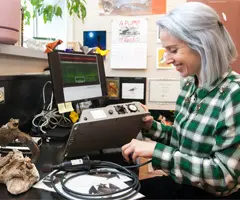
Agriculture from the air


PhD student Stephanie Arnold is helping farmers adapt to climate change by providing precision agriculture data from the air, thanks to the UPEI Climate Lab's fleet of drones.
Students may obtain a degree with a minor in Climate Change and Adaptation by successfully completing the following courses:
- ACC 1010
- ACC 1020
- ACC 2020
- ACC 2030
- ACC 3050
AND
Two of the ACC 3rd or 4th year courses excluding following courses:
- ACC 3160
- ACC 3040
- ACC 4040
High School applicants:
Successful completion of Grade 12 examinations in a University Preparatory Program with an overall average of at least 70% in the following courses:
- Grade 12 Academic English
- Grade 12 Academic Mathematics
- Two Grade 12 Academic Sciences, from the following list: Biology, Chemistry, Physics, Environmental Science, Computer Science, Oceanography, Animal Science
- One additional Grade 12 Academic course
Note: Applicants should apply by March 1 to be considered for the Roderick Stirling MacDonald entrance scholarships.
Refer to the UPEI Academic Calendar for more information.
UPEI's undergraduate tuition is very competitive, and we offer millions of dollars in scholarships and awards.
Tuition
$8,130 per year, based on 30 credit hours ($813 per 3 credit course).
International students pay $9,718 per year in addition to full-time student tuition.
For a complete breakdown of part-time or full-time study as a student in the Faculty of Science, visit our Tuition and Fees page.
Scholarships
Ten (10) entrance scholarships of $2,000 are available for students of the Bachelor of Science in Applied Climate Change and Adaptation program.
Complete our inquiry form below to find out more.
The Roderick Stirling MacDonald Scholarships
UPEI has created fifteen (15) annual Roderick Stirling MacDonald Scholarships, valued at $1,000 each, for students in the Bachelor of Science in Applied Climate Change and Adaptation program.
- Ten (10) scholarships for first-year students
- Five (5) scholarships for students entering their third year
Students with an academic average of 80 per cent or higher in their previous year of study and a passion for improving the effects of climate change are eligible for these awards.
Read more about the Roderick Stirling MacDonald Scholarships
UPEI's interesting and unique programs are enhanced by our caring and supporting faculty, instructors, and staff.


