



The Biology Department at UPEI has a strong tradition of helping people realize their potential through deep consideration of the biological world. A scientific understanding of the plants and animals is, in many ways, its own reward. But it is also a pathway to many exciting and fulfilling career opportunities. A biology program is a common route toward the health professions (human and veterinary medicine, dentistry, physiotherapy, etc.), for which we offer strong pre-professional programs. It can also lead to careers in environmental analysis, biotechnology, laboratory diagnostics, and many other things. Biology graduates also often establish other sorts of careers (lawyer, business professional) for which the knowledge of biology can be a strong personal and professional asset.
The strength of our educational programs derive from the strength of our scholarly activity and research. Our faculty hold grants from the Natural Sciences and Research Council of Canada, Canada Foundation for Innovation, Atlantic Innovation Foundation, Canadian Institutes of Health Research, and Prince Edward Island Health Research Institute, among others. Our faculty have research programs in neurobiology, arctic insect ecology, cancer cell biology, watershed ecology, pollination biology, coastal habitat ecology, animal habitat fragmentation, heart and stroke physiology, aquatic toxicology, plant ecological genetics, among others.
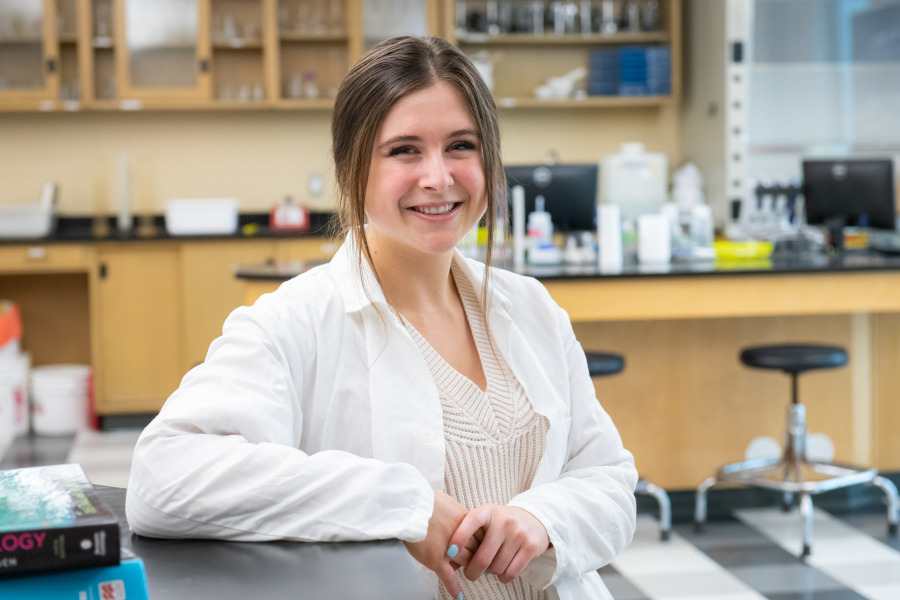
Reilly Sullivan, a fourth-year biology student and varsity athlete at the University of Prince Edward Island, has been awarded a 2023 3M National Student Fellowship by the Society for Teaching and Learning in Higher Education (STLHE).
Need more information about Biology?
The personal information requested on this form is collected under Section 31(c) of the PEI Freedom of Information and Protection of Privacy Act. Read our Disclaimer.
Note: Current UPEI students should refer to Student Planning in myUPEI and the UPEI Academic Calendar governing their entry year, and speak to an academic advisor about course requirements. The course structure presented for this program is a recommended, unofficial progression for prospective students.
Note: As per Academic Regulation 1h, all undergraduate degree programs require successful completion of IKE-1040 and a Writing Intensive Course.
Requirements for a Major in Biology
A student enrolled in the Majors program in Biology will complete a minimum of 42 semester hours in Biology, and additional courses according to the program outlined below. Students may choose to take the Integrative Biology specialization, the Biology of Health and Diseases specialization, or the Environment and Ecology specialization. Students in the ‘pre-vet’ program should follow the Biology of Health and Diseases specialization, and may select courses of interest in animal biology or other areas.
Biology 1310 and 1320 are Introductory Biology courses and are the prerequisites for upper level Biology courses. Take these courses if you plan to complete a Biology major or minor, or if your program requires one or both courses. Biology 1010 is not accepted for credit within the Biology Majors program, but can fulfill a general elective degree requirement.
Biology 1020 and 1030 are introductory courses for students in the Biology of Health and Diseases specialization, but any student may take these courses.
Biology 1060 is restricted to students enrolled in programs offered by the Faculty of Nursing.
Integrative Biology Stream
| Core Biology Courses | Hours Credit |
| Biology 1310-1320 | 6 |
| Two of Biology 2020, 2040 and 2060 | 6 |
| Two of Biology 2210, 2220 and 2230 | 6 |
| Biology 3260 or 3820 | 3 |
| at least seven additional Biology electives at or above the 2000-level that fit the following criteria: at least two must be at the 4000 level | 21 |
Required courses in other departments, and electives to total 120 semester hours of credit as listed under Specializations.
Elective courses in the Integrative Biology stream (can be used as "alternate" stream courses)
*Biology 2020 - Botany
*Biology 2040 - Zoology
*Biology 2060 - Microbiology
Biology 3120 - History of Biology
*Biology 3520 - Molecular Biology Research Techniques
*Biology 4210 - Design and Analysis of Biological Studies
The Honours program in Biology is designed to provide research experience at the undergraduate level within the BSc program. It is available to students with a strong academic background who intend to continue studies at the postgraduate level in Biology or some related field, or to students who intend to pursue a career where research experience would be an asset. Students may also carry out a research project by registering for Biology 4400 (6 semester hours of credit).
The Honours program differs from the BSc Major program in having a research and thesis component. The total number of courses is the same, five courses per semester for eight semesters, but the honours thesis course counts as 12 credits, so the total semester hours of credit for the Honours is 126, compared to 120 hours for the BSc Major. The research component is to be completed within the BSc program and may require the equivalent of one summer of research (four months) preceding the graduating year during which Biology 4900 (Advanced Research and Thesis) will be taken.
Course Requirements of the Honours Program
Students may complete an Honours Degree in the Integrative Biology specialization, or either of the Biology of Health and Diseases specialization, or the Environment and Ecology specialization). The program is the same as the Majors program with the addition of Biology 4900 (Advanced Research and Thesis), Biology 3310 (Research Methods and Communications in Biology) and two other Biology electives. These would normally be completed in the student’s final year.
Students who have completed a BSc Major in Biology at UPEI can be admitted to the Honours Conversion Program and achieve the BSc Honours designation by completing the additional course requirements of the program.
Honours Entrance Requirements
For admission to the Honours program or Honours Conversion program, students should have a combined minimum average of 70% in all previous courses, and a combined minimum average of 75% in all previous biology courses. Permission of the Department is also required and is contingent on the student finding a thesis advisor, on being assigned an advisory committee, on acceptance of the research project by the Biology Department, and on general acceptability. Students interested in doing Honours should consult with the Departmental Chair or the Coordinator of the Honours program as early as possible and apply to the program after their third year of study.
Performance
To graduate with a BSc Honours in Biology, students must complete 126 semester hours of credit which includes 12 semester hours of credit for the research and thesis, attain a minimum average of 75% in all Biology courses combined, and achieve a minimum overall average of 70% in all courses submitted for the degree. Students failing to meet these requirements may transfer their program to the BSc Major in Biology or to other degree programs.
Note: Detailed information about the Honours Program is available from the Department.
To qualify for a minor, students must complete a total of 21 semester hours of credit in Biology, 6 semester hours of which are required courses. The requirements for a minor in Biology are:
Biology 1310-1320 (6 hours of credit) and any 5 Biology electives at 2000 level or above (15 semester hours)
Total Semester Hours = 21


Students may apply for a particular specialization any time before the end of their third year. Those who have not specified a specialization must meet the requirements for the Integrative Biology specialization. The Biology of Health and Diseases specialization may be of interest to students who intend to pursue careers or graduate studies related to veterinary medicine ('pre-vet'), human health professions, or research in biomedical or biotechnological sciences. The Environment and Ecology specialization may be of interest to students interested in careers or graduate studies related to biodiversity and conservation, or wildlife biology in the modern context of climate change and human interactions. The Integrative Biology specialization will give students a broad background in biology.
Integrative Biology specialization
| Core Biology Courses | Hours Credit |
| Biology 1310-1320 | 6 |
| Two of Biology 2020, 2040, and 2060 | 6 |
| Two of Biology 2210, 2220, and 2230 | 6 |
| Biology 3260 or 3820 | 3 |
At least seven (7) additional Biology electives at or above the 2000 level that fit the following criteria:
| 21 |
Required courses in other departments, and electives to total 120 semester hours of credit. See list below.
Biology of Health and Diseases Specialization
(including Pre-Veterinary Medicine Stream)
| Core Biology Courses | Hours Credit |
| Biology 1020 or 1030 | 3 |
| Biology 1310-1320 | 6 |
| Biology 2040 and 2060 | 6 |
| Biology 2210 and 2230 | 6 |
| Foods and Nutrition 2110 or Biology 2430 | 3 |
| Biology 3260 | 3 |
| Biology 3520 or Biology 3440 | 3 |
At least six additional Biology electives at or above the 2000 level that fit the following criteria:
| 18 |
Required courses in other departments, and electives to total 120 semester hours of credit. See list below.
Environment and Ecology Specialization
| Core Courses | Hours Credit |
| Environmental Studies 1010 | 3 |
| Biology 1310-1320 | 6 |
| Biology 2020, 2040 and 2060 | 9 |
| Biology 2220 and 2230 | 6 |
| Biology 3820 | 3 |
At least seven additional Biology electives at or above the 2000 level that fit the following criteria:
| 18 |
Required courses in other departments, and electives to total 120 semester hours of credit. See list below.
Required courses from other departments
- English 1010
- IKE 1040
- One Writing Intensive Course
- Chemistry:
- Chemistry 1110 and 1120
- Chemistry 2410-2420 or Chemistry 2430 (credit will not be given for both Chemistry 2430 and Chemistry 2410 or 2420)
- Chemistry 3530 or Biology 2250 is required for the Integrative Biology specialization and Biology of Health and Diseases specialization; Chemistry 3530 or Chemistry 2020 or Biology 2250 is required for the Environment and Ecology specialization (credit will not be given for both Chemistry 3530 and Biology 2250)
- Physics:
- Physics 1210 (or 1110) and Physics 1220 (or 1120) (6 credit hours)
- Mathematics and Statistics:
- Math 1120 or Math 1910 (3 or 4 credit hours)
- Stat 1210 (formerly 2210) (3 credit hours)
- Note: Some students may wish to take upper level Mathematics, Chemistry, or Physics courses for which Mathematics 1910-1920 is required: therefore Mathematics 1910-1920 may be taken in place of Mathematics 1120 but the statistics requirement of Statistics 1210 remains. Credit will not be given for both Mathematics 1120 and Mathematics 1910.
- Other electives: The remaining number of semester hours required to complete the requirements for the Biology major will be made up from courses selected by the students.
Note: Please see Academic Regulation 14(4): Application of Certain Professional Courses.
Suggested Course Sequences
First Year (10 courses - 30 semester hours)
- Introductory Biology (BIO 1310-1320)
- Introductory Chemistry (CHEM 1110-1120)
- Calculus (MATH 1120 or 1910)
- Indigenous Teachings of Turtle Island (IKE 1040)
- Physics for the Life Sciences (PHYS 1210 and 1220)
- Academic Writing (ENG 1010)
- For the Integrative Biology specialization: one elective
- For the Environment and Ecology specialization: Introductory Environmental Studies (ENV 1010)
- For the Biology of Health and Diseases specialization: Human Health (BIO 1020) OR Animal Health (BIO 1030)
Second Year (10 courses - 30 semester hours
- Organic Chemistry (CHEM 2410-2420 or 2430)
- Statistics (STAT 1210)
- For the Integrative Biology specialization:
- Two of: Botany (BIO 2020), Zoology (BIO 2040), Microbiology (BIO 2060)
- Two of: Cell & Molecular Biology (BIO 2210), Botany (BIO 2020), Genetics I (BIO 2230)
- Electives to make up 30 semester hours of credit
- For the Environment and Ecology specialization:
- Botany (BIO 2020) AND Zoology (BIO 2040), AND Microbiology (BIO 2060)
- Ecology (BIO 2220) AND Genetics I (BIO 2230)
- Elective(s) to make up 30 semester hours of credit
- For the Biology of Health and Diseases specialization:
- Zoology (BIO 2040) AND Microbiology (BIO 2060)
- Cell and Molecular Biology (BIO 2210) AND Genetics (BIO 2230)
- Introductory Nutrition (FN 2110) OR
- Physics of the Human Body (BIO 2430)
- Electives to make up 30 semester hours of credit
Third Year (10 courses - 30 semester hours)
- For the Integrative Biology specialization:
- Physiology of Cells and Organisms (BIO 3260) OR Evolutionary Biology (BIO 3820)
- Biochemistry (CHEM 3530) OR Human
- Biochemistry (BIO 2250)
- 5 Biology Electives at or above the 2000-level
- Electives to make up 30 semester hours of credit
- For the Environment and Ecology specialization:
- Evolutionary Biology (BIO 3820)
- Environmental Chemistry (CHEM 2020) OR Biochemistry (CHEM 3530) OR Human Biochemistry (BIO 2250)
- Two Biology Electives at or above the 2000-level from the Environment and Ecology specialization List
- Two Biology Electives at or above the 2000-level chosen from courses not on the Environment and Ecology specialization List
- Electives to make up 30 semester hours of credit
- For the Biology of Health and Diseases specialization:
- Physiology of Cells and Organisms (BIO 3260)
- Molecular Biology Research Techniques (BIO 3520) OR Biomedical Imaging (BIO 3440)
- Biochemistry (CHEM 3530) OR Human Biochemistry (BIO 2250)
- Two Biology Electives at or above the 2000-level from the Biology of Health and Diseases specialization List
- One Biology Elective at or above the 2000-level from courses not on the Biology of Health and Diseases specialization List
- Electives to make up 30 semester hours of credit
Fourth Year (10 courses)
- Two Biology electives at 4000 level from the required specialization lists
- Electives to make up 30 semester hours of credit
List of Courses that may be used towards the specialization areas in Biology
Certain courses like BIO 4410 (Directed Studies) or BIO 4090 (Special Topics), or courses transferred from other universities for Biology credit, may be credited toward a specialization with prior permission of the Chair.
Elective courses in the Biology of Health and Diseases specialization
*Biology 2260 - Human Anatomy and Histology
Biology 2310 - Biological Physics of Molecules
Biology 2430 - Physics of the Human Body
*Biology 3110 - Plants and People
Biology 3750 - Medical Microbiology
Biology 3220 - Bioinformatics
*Biology 3230 - Genetics II
*Biology 3040 - Vertebrate Zoology
*Biology 3240 - Comparative Vertebrate Anatomy
*Biology 3350 - Animal Behaviour
Biology 3420 - Introduction to Medical Physics
Biology 3440 - Medical Imaging
*Biology 3710 - Life of Mammals
Biology 3720 - Virology
*Biology 4010 - Human Physiology and Pathophysiology
*Biology 4020 - Comparative & Environmental Vertebrate Physiology
*Biology 4030 - Developmental Biology
*Biology 4040 - Endocrinology
*Biology 4050 - Medical Biology
Biology 4320 - Biological Physics of Cells
Biology 4350 - Biology of Sex
Biology 4710 - Molecular Biotechnology
*Biology 4720 - Biology of Cancer and Other Diseases
Biology 4750 - Basic and Clinical Immunology
Elective courses in the Environment and Ecology specialization
Biology 2130 - Integrated Watershed Management
Biology 2630 - Climate Physics
Biology 3020 - Aquaculture and the Environment
*Biology 3040 - Vertebrate Zoology
*Biology 3140 - Plant Community Ecology
*Biology 3270 - Field Coastal Ecology
*Biology 3350 - Animal Behaviour
*Biology 3610 - Biology of Fishes
*Biology 3710 - Life of Mammals
*Biology 3910 - Marine Biology
*Biology 4110 - Wildlife Biology
*Biology 4130 - Conservation Genetics
*Biology 4520 - Biogeography and Macroecology
*Biology 4540 - Biodiversity and Conservation Ecology
*Biology 4620 - Watershed Ecology
*Biology 4650 - Marine Community Ecology
*Biology 4660 - Plant-Animal Interactions
*Biology 4850 - Environmental Toxicology
Other Biology electives not designated as specialization electives in the Environment and Ecology or Biology of Health and Diseases specializations
*Biology 2020 - Botany
*Biology 2040 - Zoology
*Biology 2060 - Microbiology
Biology 3120 - History of Biology
Biology 3310 - Research Methods and Communications in Biology
*Biology 3520 - Molecular Biology Research Techniques
Biology 3620 - Computational Biology
Biology 3820 - Evolutionary Biology
Biology 3900 - Work Integrated Learning in the Biological Sciences
*Biology 4210 - Design and Analysis of Biological Studies
Note: Students who plan to complete a minor in Medical and Biological Physics should consult with the Physics Department to verify the eligibility of Biology courses that are cross-listed with Physics courses.
The UPEI Co-op Program is an integrated approach to university education which enables students to alternate academic terms on campus with work terms in suitable employment. The success of such programs is founded on the principle that students can apply theoretical knowledge from course studies in the workplace and return to the classroom with practical workplace experience. Students who successfully complete all the requirements of the program will have the notation entered on their transcripts and on the graduation parchment.
Students accepted into the program complete at least three paid work terms of 14 to 16 weeks' duration, and a series of career skills courses. Credits earned through completion of work terms are counted as general electives.
The Co-op option is available to full-time students in the Biology Major or Honours program Applications to the Co-op Education Program are normally made after completion of the first year of study. Credits earned through completion of work terms are counted as general electives.
Visit the Co-operative Education Program website for more information.
High School Graduates
Canadian High School Equivalency Chart
- Grade 12 Academic English
- Grade 12 Academic Mathematics
- Two Grade 12 Academic Science subjects (acceptable subjects: Chemistry, Biology, Physics, Computer Science, Oceanography, Animal Science, Environmental Science)
- One additional Grade 12 Academic course
Please note: Successful completion of Grade 12 Chemistry (or equivalent) is required as a prerequisite for permission to register in CHEM-1110.
Please refer to the UPEI Academic Calendar for complete admissions information.
UPEI's undergraduate tuition is very competitive, and we offer millions of dollars in scholarships and awards.
Tuition
$8,130 per year, based on 30 credit hours ($813 per 3 credit course).
International students pay $9,718 per year in addition to full-time student tuition.
For a complete breakdown of part-time or full-time study as a student in the Faculty of Science, visit our Tuition and Fees page.
Scholarships and Awards
UPEI supports you and your educational goals. We administer millions of dollars in scholarships and awards to our undergraduate and graduate students every year. Depending on your faculty or program, and year of study, you may be eligible for available awards.
Search the complete list of scholarships for information and application forms.
Celebrating Student Achievement
Including Guaranteed Entrance Scholarships and Academic Excellence Awards, these awards recognize the academic achievements of all students who meet the eligibility criteria while studying towards their first undergraduate degree.
Visit the Scholarships site for complete information.
UPEI's interesting and unique programs are enhanced by our caring and supporting faculty, instructors, and staff.


