


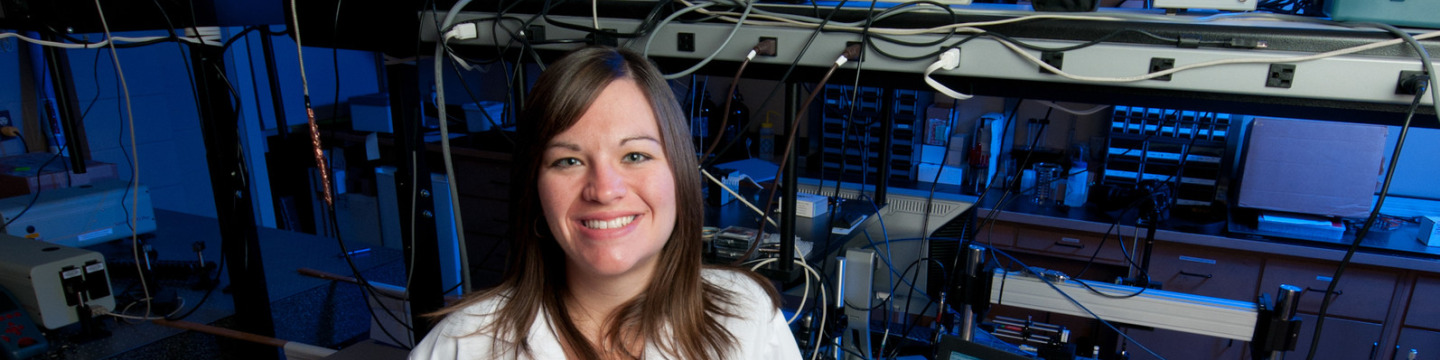
Physics is recognized internationally as a great foundational degree for many careers including in science, industry, education, business, law, and medicine. Physics explores many of the deeper mysteries of the universe and can lead to a wide range of intriguing career and employment opportunities.
A key focus of UPEI's physics programs is on experiential learning, including opportunities to work with companies and organizations in PEI and across Canada (co-op program) or to work with physics faculty on campus in summer research positions (major and honours programs). These positions are all paid and they give you a chance to experience different types of jobs, workplace settings and employers, and gain important transferable skills, all while you are a physics student at UPEI.
Some of our recent physics graduates have gone on to graduate school, others to medical school, some have received education degrees and are teaching in the school system, some are professors and researchers at Universities, and others are working in industry.
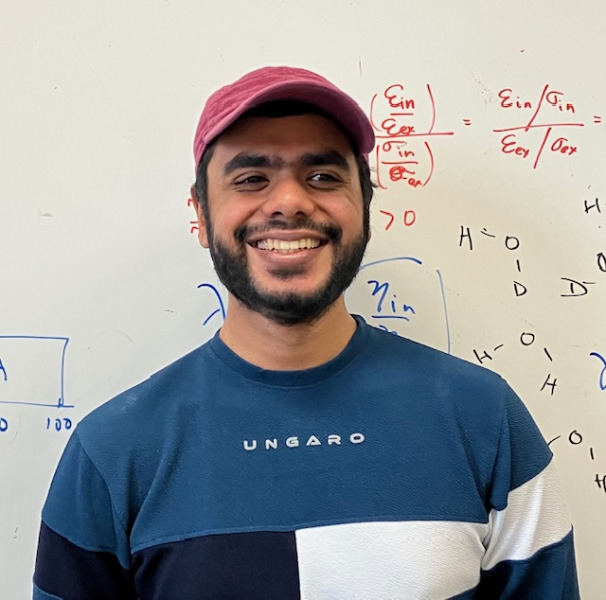
Nishel Alexander, a fourth-year honours student in physics at UPEI, won second place in the poster competition in the association’s Division of Physics in Medicine and Biology at the 2023 Canadian Association of Physicists (CAP) Congress held at the University of New Brunswick in June.
Need more information about Physics?
The personal information requested on this form is collected under Section 31(c) of the PEI Freedom of Information and Protection of Privacy Act. Read our Disclaimer.
Note: Current UPEI students should refer to Student Planning in myUPEI and the UPEI Academic Calendar governing their entry year, and speak to an academic advisor about course requirements. The course structure presented for this program is a recommended, unofficial progression for prospective students.
Note: As per Academic Regulation 1h, all undergraduate degree programs require successful completion of IKE-1040 (new for students beginning or returning after re-application in Fall 2022); one of UPEI-1010, UPEI-1020, or UPEI-1030, and a Writing Intensive Course.
The Honours program in Physics is intended to provide research experience at the undergraduate level. It is designed for students who are interested in continuing their studies at the graduate level in Physics or related fields, or who are planning careers where research experience would be an asset.
The Honours program comprises a total of 126 semester hours of course credit, including a research project and thesis worth 12 semester hours. A total of at least 60 semester hours of Physics is required.
The normal University requirements must be met in addition to the departmental requirements listed below. Biology 1310 and 1320 are highly recommended electives.
| First Year | Semester hours |
|
Physics 1110-1120 Physics for Physical Sciences I and II |
6 8 3 6 3 6 |
| Second Year | Semester hours |
|
Physics 2010 Waves and Oscillations |
3 |
| Third and Fourth Years | Semester hours |
|
Physics 3010 Advanced Mechanics |
3 3 3 3 3 3 3 3 3 6 6 3 3 3 15 |
| Total | 126 |
Entrance Requirements
For admission to the program, students must normally have a minimum average of 70% in all previous courses and a minimum average of 75% in all previous Physics courses. First-class or high second-class standing in all previous Physics courses is expected. Permission of the Department is required.
Acceptance will be contingent upon the student finding a project supervisor, and the Department’s assessment of the student’s suitability for the program. Students interested in doing Honours should consult the Department Chair as early as possible, normally before the beginning of the student’s third year, and no later than January 31 of the third year. Before registering for Physics 4901, the student must have been accepted into the Honours program, and the project topic must be approved by the Department.
To graduate with Honours in Physics, the student must maintain a minimum average of 75% in all Physics courses combined. Students must also maintain a minimum overall average of 70% in each of the four years of study.
Students can specialize in Medical and Biological Physics within the Honours in Physics program.
| First Year | Semester hours |
|
Physics 1110-1120 Physics for Physical Sciences I and II |
6 8 6 3 6 3 |
| Second Year | Semester hours |
|
Physics 2010 Waves and Oscillations |
3 |
| Third and Fourth Years | Semester hours |
|
Physics 3010 Advanced Mechanics |
3 |
| Total | 126 |
The honours research project will be relevant to Medical or Biological physics.
Students who intend to major in Physics are advised to consult the Department before registration. The normal University requirements must be met in addition to the Departmental requirements listed below. In exceptional cases, courses may be taken in a different sequence provided that the pertinent prerequisites are fulfilled or permission is granted by the Department.
| First Year | Semester hours |
|
Physics 1110-1120 Physics for Physical Sciences I and II |
6 8 6 3 3 6 |
| Second Year | Semester hours |
|
Physics 2010 Waves and Oscillations |
3 3 3 3 3 3 3 4 6 |
| Third Year | Semester hours |
|
Physics 3120 Electromagnetism I |
3 |
| Total | 120 |
Students can specialize in Medical and Biological Physics within the Honours Major in Physics program.
| First Year | Semester hours |
|
Physics 1110-1120 Physics for Physical Sciences I and II |
6 8 6 3 6 3 |
| Second Year | Semester hours |
|
Physics 2010 Waves and Oscillations |
3 |
| Third and Fourth Years | Semester hours |
|
Physics 3120 Electromagnetism I |
3 3 3 3 3 3 3 3 3 30 |
| Total | 120 |
Students in the Minor Program in Physics must complete a total of 21 semester hours of Physics including:
- Physics 1110 – 3 hours
- Physics 1120 – 3 hours
- Physics 2210 – 3 hours
- Four additional Physics courses (12 semester hours) at the 2000 level or above.
Students intending to do a Minor in Physics are advised to take Mathematics 1910-1920 instead of 1120.
Students in the Minor Program in Medical and Biological Physics must complete a total of 21 semester hours of course credit, including:
- Physics 1210 Physics for Life Sciences I or Physics 1110 Physics for Physical Sciences I – 3 hours
- Physics 1220 Physics for Life Sciences II or Physics 1120 Physics for Physical Sciences II – 3 hours
- Physics 2430 Physics of the Human Body – 3 hours
The remaining four (4) electives (12 semester hours) must be chosen from the following suite of courses:
- Physics 1510 Life in the Universe – 3 hours
- Physics 2210 Modern Physics – 3 hours
- Physics 2420 Introduction to Biomechanics – 3 hours
- Physics 2630 Climate Physics – 3 hours
- Physics 3420 Introduction to Medical Physics – 3 hours
- Physics 3430 Research Project – 3 hours
- Physics 3510 Analysis of Human Movement – 3 hours
- Physics 3520 Biomedical Imaging – 3 hours
- Physics 3910 Radiation Detection and Measurement – 3 hours
- Biology 2260 Human Anatomy and Histology – 3 hours
- Biology 4010 Human Physiology and Pathophysiology OR Biology 4020 Comparative and Environmental Vertebrate Physiology (but not both) – 3 hours
- RAD 2310 Radiographic Physics – 3 hours (available only to students in the Radiography program)
The UPEI Co-op Program is an integrated approach to university education which enables students to alternate academic terms on campus with work terms in suitable employment. The success of such programs is founded on the principle that students are able to apply theoretical knowledge from course studies in the workplace and return to the classroom with practical workplace experience. Students who successfully complete all the requirements of the program will have the notation entered on their transcripts and on the graduation parchment.
Students accepted into the program complete at least three paid work terms of normally 14 – 16 weeks duration, but at least 12 weeks, and three professional development courses. Credits earned through completion of work terms are counted as general electives.
The Co-op option is available to full-time students in the Physics Major or Honours program. Applications to the Co-op Education Program are normally made after completion of the first year of study.
Visit the Co-operative Education Program website for more information.
High School Graduates
Canadian High School Equivalency Chart
- Grade 12 Academic English
- Grade 12 Academic Mathematics
- Two Grade 12 Academic Science subjects (acceptable subjects: Chemistry, Biology, Physics, Computer Science, Oceanography, Animal Science, Environmental Science)
- One additional Grade 12 Academic course
Please note: Successful completion of Grade 12 Chemistry (or equivalent) is required as a prerequisite for permission to register in CHEM-1110.
Please refer to the UPEI Academic Calendar for complete admissions information.
UPEI's undergraduate tuition is the second-lowest in the Atlantic region, and we offer millions of dollars in scholarships and awards.
Tuition
$6,828 per year, based on 30 credit hours ($682.80 per 3 credit course).
International students pay $8,010 per year in addition to full-time student tuition.
For a complete breakdown of part-time or full-time study as a student in the Faculty of Science, visit our Tuition and Fees page.
Scholarships and Awards
UPEI supports you and your educational goals. We administer millions of dollars in scholarships and awards to our undergraduate and graduate students every year. Depending on your faculty or program, and year of study, you may be eligible for available awards.
Search the complete list of scholarships for information and application forms.
Celebrating Student Achievement
Including Guaranteed Entrance Scholarships and Academic Excellence Awards, these awards recognize the academic achievements of all students who meet the eligibility criteria while studying towards their first undergraduate degree.
Visit the Scholarships site for complete information.
UPEI has about 250 faculty—exceptional scholars, teachers, and mentors, with more being hired each year as we open new, progressive, and unique programs. But the story isn’t just in the numbers. It’s in the quality of our people. Award-winning faculty from around the globe have made UPEI home. Here, you’ll learn directly from these world-class professors and researchers in small classes where you’ll have easy access to them.

Dr. Bill Whelan, professor of physics at UPEI, was recently elected president of the Canadian Association of Physicists (CAP) for 2023–2024.


